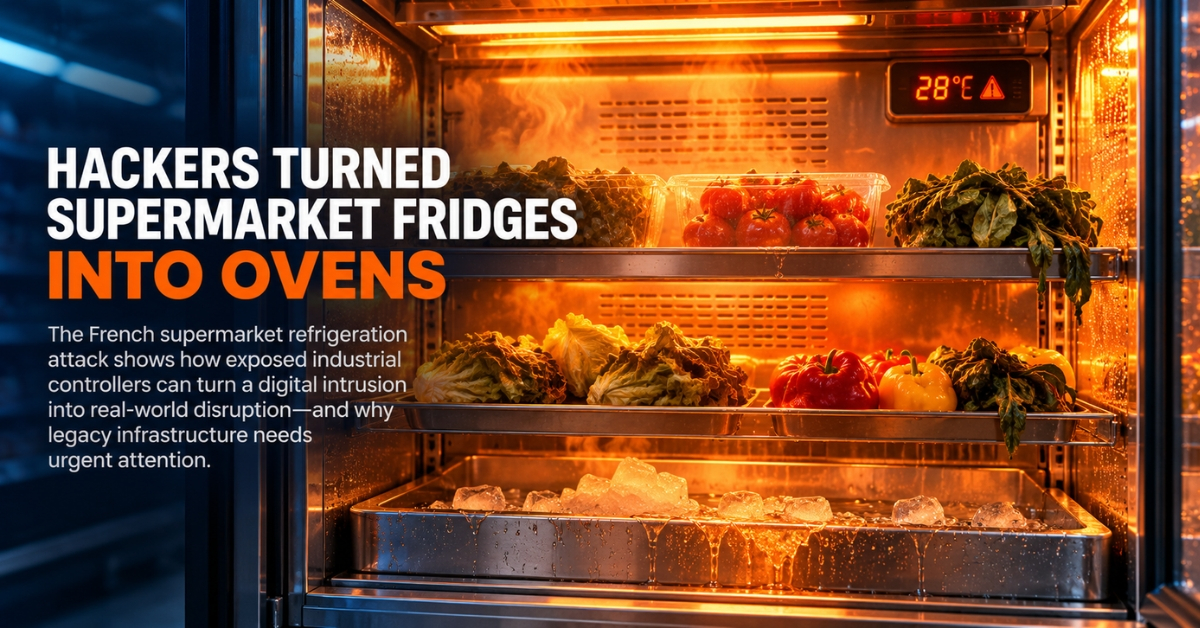
A supermarket freezer is supposed to do one thing exceptionally well: stay cold.
But during the night of 11–12 October 2026, that simple function became a serious vulnerability. Across hundreds of French supermarkets, refrigeration systems were remotely manipulated. Temperatures climbed. Frozen food thawed. Cold rooms overheated. In some locations, the heat reportedly triggered fires and sprinkler systems.
By morning, staff were dealing with spoiled stock, damaged equipment and disrupted operations.
There was no need to encrypt the supermarket’s files, steal customer databases or shut down its website. The attackers had found another way to cause damage: they targeted the systems responsible for keeping food safe.
The incident has since become a striking example of how a cyberattack can cross the boundary between the digital and physical worlds.
Reporting by The Guardian, Reuters, Le Monde and Associated Press documented the scale of the disruption. France’s national cybersecurity agency, CERT-FR, subsequently confirmed numerous compromises involving remote refrigeration controllers from multiple manufacturers. <Cite refs={["turn319839search0","turn277611news39","turn418281news42","turn418281search0"]}/>
What did the cyberattack cause inside the supermarkets?
The cyberattack unfolded overnight, when most stores were closed or operating with limited staff. Connected refrigeration controllers manage equipment such as freezers, chilled display cabinets and cold-storage rooms. They allow operators and maintenance contractors to monitor temperatures, adjust settings and respond to equipment faults remotely.
During the attack, these controls were manipulated.
According to reporting by Le Monde, some systems were forced into prolonged defrost cycles. A defrost cycle is a normal refrigeration function that removes accumulated ice. But when it runs for too long, the equipment can lose its ability to maintain safe temperatures.
In affected stores, temperatures reportedly reached approximately 50°C. Some individual incidents involved even higher readings. The result was the opposite of what refrigeration equipment is designed to achieve: instead of preserving food, the systems accelerated its deterioration. <Cite refs={["turn277611search0","turn319839search0"]}/>
The damage was not limited to merchandise.
At one store, an overheated cold room reportedly triggered a sprinkler system, flooding the storage area. Other reports described heat-damaged equipment and significant quantities of discarded fresh and frozen products.
The financial consequences quickly became apparent. A senior executive at a leading French supermarket group estimated that losses across the affected business could reach tens of millions of euros in a single day. The total cost across all affected retailers has not been conclusively established in the reporting available as of 29 October 2026. <Cite refs={["turn277611news39","turn277611search0","turn319839search0"]}/>
How could hackers control a refrigerator?
The key to understanding this incident is the refrigeration controller.
Modern commercial refrigeration is not simply a collection of compressors and thermostats. It is an operational technology (OT) environment: connected equipment, control software, sensors and remote-management interfaces working together to maintain physical processes.
These systems are valuable because they make large facilities easier to manage. A technician can monitor equipment remotely, diagnose problems and change settings without travelling to every store.
But remote access also creates risk.
France's CERT-FR reported compromises affecting several families of remote refrigeration controllers, including equipment from a Danish refrigeration-controls manufacturer and other vendors. Its advisory identified the affected product families and warned that exposing management interfaces directly to the internet was contrary to security best practice. <Cite refs={["turn418281search0","turn418281news41"]}/>
The investigation's findings require an important distinction.
Early coverage focused on known vulnerabilities and outdated firmware in some controller models. However, on 22 October, Silicon UK reported that the head of France's cybersecurity agency told lawmakers that the agency's assessment pointed to basic security failures, including direct internet exposure and weak passwords. He said the agency did not believe the earlier-identified software vulnerabilities had been exploited in this particular attack. <Cite refs={["turn319839search1","turn319839search8"]}/>
That distinction matters. The precise initial access method has not been conclusively established in the public reporting reviewed for this article. It would therefore be inaccurate to claim that a particular vulnerability, password or exploit definitively enabled the entire campaign.
What is established is that remote refrigeration controllers were compromised and that insecure exposure and inadequate protection were central concerns raised by investigators.
The overlooked problem: Equipment nobody owns completely
One of the most revealing aspects of this incident is the division of responsibility.
Supermarkets depend on refrigeration specialists to install, maintain and remotely manage their cooling equipment. The retailer may own the store, the refrigeration contractor may administer the controller, and the equipment manufacturer may provide the software and firmware.
That creates a difficult question: who is accountable for the security of the complete system?
A retailer might have a mature corporate cybersecurity programme, protected employee devices and a well-managed cloud environment. Yet a controller maintained by a third party could remain directly accessible from the public internet.
If that controller sits outside the retailer's central security monitoring, its exposure may not appear on the security team's radar.
This is not a problem unique to supermarkets. Similar arrangements exist in manufacturing plants, hospitals, warehouses, commercial buildings and logistics facilities. In each case, equipment that was originally procured to perform a physical function has become part of the organisation's digital attack surface.
The incident is a reminder that outsourcing maintenance does not remove the need for security oversight.
The danger extended beyond one manufacturer
As the investigation developed, the scope widened beyond the initially discussed refrigeration systems.
On 13 October, CERT-FR expanded its advisory to include additional remote-controller families. Le Monde also reported attacks involving equipment from another refrigeration technology provider, including an incident in which staff and technicians detected abnormal temperature changes before significant food losses occurred at one store. Other affected equipment was reported to have suffered losses. <Cite refs={["turn418281search0","turn277611search1"]}/>
The wider lesson is that organisations should not assume they are safe simply because they use a different manufacturer.
The relevant questions are broader:
Is the equipment connected directly to the internet?
Is its firmware current and supported?
Can remote users change operational settings?
Are temperature changes and alarm configurations monitored independently?
Can the equipment be isolated quickly if compromise is suspected?
These are asset-management and operational-resilience questions as much as cybersecurity questions.
What is the current status?
As of 29 October 2026, French authorities have issued specific mitigation guidance, while public reporting indicates that the investigation into the attackers and their methods remains unresolved.
CERT-FR's advisory, last updated on 16 October, warns that attack campaigns may still be underway. It identifies several affected refrigeration-controller product families and provides instructions for securing them. <Cite refs={["turn418281search0","turn418281search2"]}/>
The guidance is clear: remove direct internet exposure from affected equipment and other exposed units, and restore remote access only through a secure VPN or protected network. Where an emergency requires it, restricting access to trusted source IP addresses may serve as a temporary measure, but it should not be treated as a permanent solution.
Operators should also update firmware where supported, change default passwords, apply recommended security settings and verify the equipment's configuration before returning it to service.
For compromised equipment, CERT-FR recommends restarting or restoring the controller as appropriate. But a factory reset is not enough if the underlying device remains vulnerable. An unsupported, end-of-life controller that is returned to the internet without adequate protection may simply be compromised again. <Cite refs={["turn418281search0","turn277611search5"]}/>
The operational recovery also required physical checks. Refrigeration systems had to be brought back under control, unsafe products removed, equipment inspected and stock replenished. A computer system can report that a controller is online, but that alone does not prove the food is safe or that every temperature setting has been restored correctly.
No publicly identified individual or group has claimed responsibility in the reporting reviewed for this article, and the full financial impact remains uncertain. <Cite refs={["turn319839search0","turn319839search1"]}/>
What Indus recommends: Secure the systems that keep business running
At Indus Systems and Services Pvt Ltd, we believe this incident reinforces a principle that applies across industries: cybersecurity must extend beyond IT infrastructure to the operational systems on which business continuity depends.
Organisations should begin with a complete inventory of connected OT and IoT assets, including refrigeration controllers, building-management systems, factory equipment and third-party-maintained devices. Identify who owns each asset, who can access it remotely, whether it is internet-facing and whether the manufacturer still supports it. Eliminate direct public exposure wherever possible and route legitimate maintenance access through a protected network or VPN with strong authentication and least-privilege permissions. Segment OT environments from corporate IT networks so that a compromise cannot spread unchecked. Monitor configuration changes and unusual operating conditions, and validate critical readings through independent alarms or sensors where appropriate. Unsupported equipment should have a documented replacement or compensating-control plan. Finally, rehearse incident-response procedures that bring IT, facilities, operations, vendors and business continuity teams together. Secure infrastructure is not simply infrastructure that is difficult to breach; it is infrastructure whose failure can be detected, contained and recovered from safely.
The bigger lesson: Cybersecurity is no longer confined to screens
The French supermarket attack did not need to bring down a payment system or expose a customer database to have a serious impact.
It interfered with the physical process that kept food safe.
That is what makes the incident important for every business operating connected infrastructure.
The consequences of a compromised system depend on what that system controls. In a supermarket, it may be refrigeration. In a factory, it may be a production line. In a hospital, it may be environmental controls supporting sensitive equipment or supplies.
The next major cyber incident may not begin with a ransom note or a stolen database. It may begin with an operational setting that quietly changes overnight.
If a system connected to your business were manipulated tomorrow, would you know before the damage became visible?
That is a question worth answering now—not after the alarms go off.