At around 8:00 a.m. on June 23, 2026, a leading Indian automotive manufacturer valued at roughly ₹3.1 lakh crore discovered something every enterprise IT team dreads.
A ransomware attack had hit its systems.
The incident affected both the manufacturer and its wholly owned technology subsidiary, which works across technology development, engineering and research.
The company responded quickly.
Its technical teams, management and external cybersecurity experts activated containment measures. The incident was reported to CERT-In, as required under Indian law.
And, based on the information available at the time, the company said the mitigation effort had been successful.
But the incident raises a much bigger question for India's manufacturing sector:
What happens when the systems behind a factory become the target?
Because a modern manufacturing business is no longer just a collection of factories, machines and supply chains.
It is a deeply connected digital ecosystem.
And ransomware knows it.
The Attack Was Detected Early
The company disclosed the incident through a regulatory filing on June 23.
It stated that the ransomware incident had occurred at approximately 8:00 a.m. IST and affected systems belonging to both the parent company and its technology subsidiary.
The immediate response involved the company's technical team, external cybersecurity specialists and senior management.
Rather than waiting to determine the full extent of the incident before acting, the organisation initiated precautionary actions and protocols intended to contain the attack.
The company subsequently stated that these measures had been successful based on the information available at that time.
That response is important.
With ransomware, time matters.
The longer an attacker remains inside an enterprise environment, the greater the opportunity for lateral movement, privilege escalation, data discovery and potentially data exfiltration.
Early detection can therefore make the difference between a contained security event and a business-wide crisis.
But This Wasn't Just an IT Incident
For an automotive manufacturer, IT infrastructure sits behind almost every stage of the business.
Product engineering.
Research and development.
Supplier coordination.
Procurement.
Production planning.
Inventory.
Dealer systems.
Customer service.
Sales.
After-sales support.
Many of these functions depend on applications, databases, networks, endpoints and cloud infrastructure working together.
That creates a particular ransomware risk.
An attacker doesn't necessarily need to shut down a production line directly.
Disrupt the systems supporting the production ecosystem and the operational consequences can follow.
This is why manufacturing cybersecurity increasingly overlaps with business continuity and operational resilience.
The question isn't simply:
"Can we protect our servers?"
It is:
"Can the business continue if critical digital systems become unavailable?"
The Most Important Detail: What We Don't Know
There has been considerable speculation about the attack since it became public.
But the confirmed facts are more limited.
The company confirmed ransomware.
It confirmed that systems at the parent company and technology subsidiary were affected.
It confirmed that response and containment measures were initiated.
It confirmed that the incident was reported to CERT-In.
What it did not publicly disclose was equally significant.
There was no public confirmation of:
The ransomware group involved
The specific ransomware variant
A ransom demand
The amount demanded
Confirmed data exfiltration
The volume of data potentially accessed
A specific initial access vector
The Record noted these gaps in its reporting on the incident, while UpGuard similarly reported that no specific threat actor had been identified and that the company had not disclosed whether data had been compromised.
That means the incident should not be presented as a confirmed data-theft event.
It was a confirmed ransomware attack.
The extent of any data compromise remained undisclosed in the public information available. That distinction matters.
The Factory Kept Moving
Perhaps the most important development came three days later.
On June 26, the company said its key business functions were operating normally.
Manufacturing.
Sales.
Service.
Dealer support.
Customer services.
Other key business operations.
All were reported to be functioning normally while the investigation continued.
That update changed the nature of the story.
The attack had reached enterprise IT systems.
But it had not, based on the company's public statements, translated into a prolonged shutdown of manufacturing operations.
For a large manufacturer, that is a critical distinction.
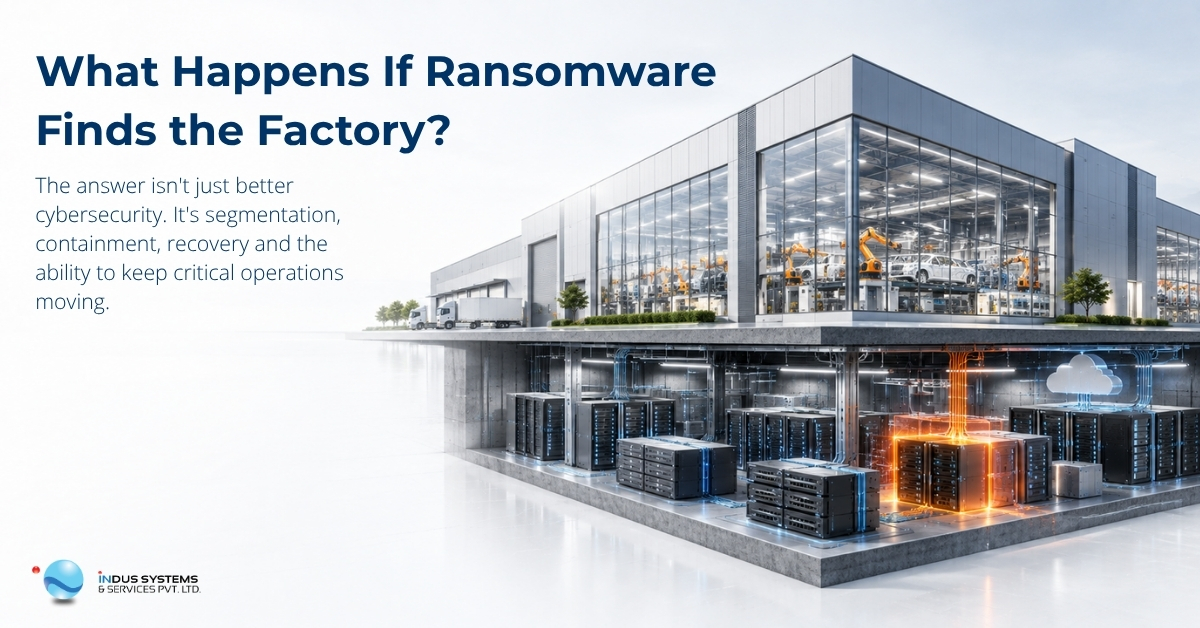
The ability to maintain production and customer-facing operations while investigating a cyber incident demonstrates why segmentation, containment and business continuity planning matter.
A resilient enterprise does not necessarily prevent every attack.
It prevents one compromised environment from taking the entire business down with it.
The Stock Market Noticed
Cybersecurity incidents increasingly have consequences outside the IT department.
On June 24, the company's shares fell by as much as 2.5%, making it the top Nifty loser at one point during trading, according to Moneycontrol.
The decline occurred against the backdrop of a major corporate event: June 24 was the record date for the company's proposed ₹5,632-crore share buyback.
That doesn't establish that the cyberattack alone caused the entire share-price movement. Markets respond to multiple factors.
But the reaction illustrates something important.
Cybersecurity is increasingly an investor issue.
When a listed enterprise discloses a ransomware incident, investors immediately begin asking:
What was affected?
How long will recovery take?
Was data stolen?
Could production be disrupted?
Are customers affected?
Could there be regulatory or legal consequences?
What will remediation cost?
The cyber incident therefore becomes part of the company's broader risk profile.
Why Manufacturing Is an Attractive Target
Manufacturers are attractive ransomware targets for a simple reason:
They depend on continuity.
A manufacturing ecosystem can contain thousands of interconnected systems and third parties.
An organisation may have:
Corporate IT
Engineering systems
Manufacturing applications
ERP platforms
Supply-chain systems
Warehouse technology
Dealer networks
IoT devices
Remote access infrastructure
Cloud workloads
Third-party connections
Every connection can create another potential attack surface. And technology subsidiaries add another layer.
In this case, the attack affected not only the manufacturer's corporate environment but also its technology-focused subsidiary.
That matters because engineering and technology environments may contain highly valuable intellectual property, product-development information and specialised systems.
The cyber risk therefore extends beyond operational downtime.
It can potentially become an intellectual-property risk and supply-chain risk.
What the Incident Says About Cyber Resilience
There is a temptation to define successful cybersecurity as:
"We weren't attacked."
That definition no longer works.
Large enterprises will continue to be targeted.
The more useful question is:
"What happens after detection?"
In this case, the publicly disclosed sequence was relatively straightforward:
Detection → response → containment → investigation → operational continuity.
The company involved internal teams, external cybersecurity specialists and management. It reported the incident to CERT-In. And within three days, it publicly stated that manufacturing and other key business functions were operating normally.
That is the essence of cyber resilience.
Not assuming that prevention is perfect.
Preparing for the moment prevention fails.
What Indus Suggests Companies Should Do
Manufacturers should design cybersecurity around operational continuity, not just perimeter defence.
That means separating critical environments through network segmentation so that a compromise in corporate IT does not automatically provide a pathway into production or engineering systems.
Identity security should be strengthened with multi-factor authentication, privileged access management and Zero Trust principles, particularly for remote access and administrator accounts.
Endpoint Detection and Response (EDR) and Extended Detection and Response (XDR) should provide continuous visibility across endpoints, servers and workloads, while 24×7 monitoring can help identify unusual activity before it becomes a major disruption.
But prevention is only half the equation.
Manufacturers also need immutable and, where appropriate, air-gapped backups for critical systems, regularly tested disaster-recovery procedures and clearly defined recovery priorities.
Recovery plans should answer a practical question:
If our most important systems were unavailable tomorrow morning, what would we restore first—and how quickly?
That answer should be known before the ransomware arrives.
The Bigger Lesson
This incident did not result in the prolonged manufacturing shutdown that many ransomware attacks have caused elsewhere.
But that doesn't make it insignificant.
It demonstrates how deeply cybersecurity is now connected to manufacturing continuity, investor confidence, technology operations and supply-chain resilience.
And it highlights an uncomfortable truth.
The modern factory doesn't end at the factory floor.
It extends into servers.
Cloud platforms.
Engineering systems.
Endpoints.
Applications.
Networks.
Partners.
And people.
Protecting the physical operation therefore requires protecting the digital infrastructure that enables it.
Because when ransomware enters a manufacturing environment, the biggest question isn't necessarily whether a computer will be encrypted.
It's whether the business can keep moving while the security team works to stop it. Are you ready to handle such a catastrophe? Find out with Indus.