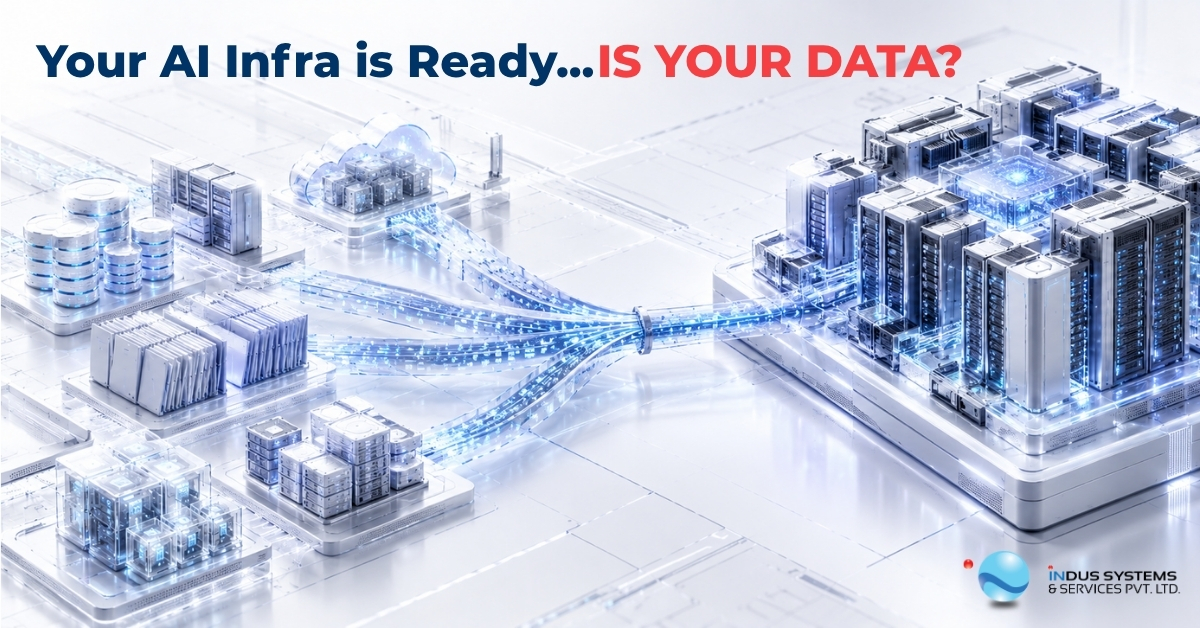
The AI conversation has been dominated by one thing: compute. More GPUs. More processing power. Faster servers. Larger models.
But there is a problem hiding underneath all that, AI cannot perform better than the data it can access.
An enterprise may have powerful servers and high-performance compute, but if its data is scattered across storage systems, private clouds, applications, file repositories and backup environments, the AI workload can still struggle.
This is becoming a real infrastructure challenge. Gartner now identifies data readiness as one of the major barriers to enterprise AI, with more than 75% of organisations prioritising investment in AI-ready data.
The question for IT leaders is therefore changing.
It is no longer only, “Do we have enough compute for AI?”
It is also, “Can our infrastructure deliver the right data to AI, at the right speed, with the right controls?”
AI Needs More Than Compute
Consider how enterprise data actually exists today.
Customer records may sit in databases. Engineering information may live in large file repositories. Business documents may be spread across collaboration platforms. Application data may sit in private cloud environments. Historical information may remain in archives. And critical data may also exist inside backup and recovery systems.
AI needs to work across this information.
That creates a very different infrastructure requirement.
The storage layer must support large volumes of data and high-speed access. Networking needs to move information efficiently between systems. Compute needs to receive data without sitting idle. And the entire environment needs appropriate security, governance and monitoring.
Dell's 2026 research found that 80% of surveyed decision-makers considered storage performance and data access bigger bottlenecks than raw compute capacity for many critical workloads.
That is an important signal.
The AI infrastructure conversation is moving from compute capacity to data delivery.
Your Data May Be Valuable. But Is It AI-Ready?
There is another challenge. Having data is not the same as having useful data.
AI needs context. It needs relevant information. It needs data that can be accessed, understood and governed for a specific business use case.
This is particularly important as organisations move beyond simple generative AI experiments and start building enterprise applications, RAG environments and AI agents.
Gartner's current guidance highlights the importance of metadata, data quality, lineage, governance and continuous data management. It also notes that AI-ready data cannot be treated as a one-time preparation exercise. It needs to evolve with the AI use case.
This means infrastructure teams need to look beyond the server.
They need to understand the entire data path.
Where does the data reside?
How quickly can it be accessed?
How is it stored?
How is it protected?
How does it move between environments?
And what happens when the AI workload grows?
This Is Where AI Infrastructure Architecture Matters
There is no single product that solves this problem.
The answer is an architecture.
For some enterprises, that may mean modernising storage. For others, it may mean upgrading servers, consolidating infrastructure or creating a more efficient hybrid cloud environment. In many cases, it means doing several of these things together.
This is an area where Indus Systems and Services Pvt Ltd has considerable experience.
Our Hybrid IT Infrastructure practice covers servers, storage, networking, private cloud, public cloud and monitoring. We work across the infrastructure lifecycle, from planning and design through deployment and ongoing support.
Our success stories reflect this approach.
We have helped organisations modernise pharmaceutical environments with hyperconverged infrastructure, support storage optimisation for engineering workloads, transform enterprise infrastructure in retail, and build hybrid cloud environments for pharmaceutical and financial organisations.
The common principle is simple.
The infrastructure has to be designed around the workload.
AI is simply making that principle more important.
Data Protection Cannot Be an Afterthought
There is another part of the AI infrastructure equation that is easy to overlook. Data protection.
The more valuable the data becomes, the more important it is to protect it.
An enterprise building AI applications may be combining business records, intellectual property, customer information and operational data into new AI workflows. Losing access to that information can affect far more than an individual application.
Backup, disaster recovery and cyber resilience therefore need to be part of the architecture from the beginning.
Indus provides enterprise backup, disaster recovery planning and BCP-DR automation as part of its infrastructure portfolio. Our success stories also include modernising backup environments for pharmaceutical organisations and strengthening recovery capabilities across enterprise environments.
This creates a more complete view of AI readiness.
The objective is not simply to make data available to an AI workload.
It is to make that data available, scalable, secure and recoverable.
The Next AI Investment May Not Be Another GPU
AI will continue to require powerful compute. But compute alone will not determine whether an enterprise AI strategy succeeds.
The organisations that move from AI pilots to production will need infrastructure that can bring together compute, storage, networking, hybrid cloud, security and data protection. They will need to know where their data is and how quickly it can reach the workloads that need it.
Most importantly, they will need an infrastructure strategy that can evolve as those workloads change.
That is the shift taking place today.
AI readiness is no longer just about building more compute.
It is about building an infrastructure that can turn enterprise data into something AI can actually use.
And before you ask whether your organisation has enough GPUs, there may be a more important question to ask: Is your data ready? Find out.